WHAT'S NEW?
Loading...
Showing posts with label Politics. Show all posts


I talked about the FBI attempting to force Apple to unlock their iPhone for them, but now it seems like the FBI doesn't need that anymore. That's because they've allegedly hacked the encryption on the iPhone themselves, and are already agreeing to help Arkansas prosecutors hack their iPhone as well. While we don't know exactly how the FBI hacked the iPhone, we do know one thing. If it can be done to one, it can be done to them all. Most people aren't against the government having the ability to get into their homes if they're breaking the law (and for probable reason) but this isn't just one phone. Imagine the government making a master key that can unlock every person's house door. What if it got stolen? What if a corrupt official were to use it without probable cause? These kinds of questions are what are being raised about the technique the FBI used to hack the iPhone.

Not only is this bad news for us, but it's also bad news for Apple. Now there is a security issue in their phones, which can cause people to not buy them. This is the government directly getting in the way of free enterprise. If the government keeps this all-access key instead of giving it up to Apple to fix, I can only see Apple retaliating. For a country that is so lucky to have so many tech giants' headquarters reside, it sure is odd that our government is so against technological progress.

Thankfully, the government probably won't have use for this vulnerability for much longer. Since it's almost inevitable that an exploit like this will not stay a secret, it will eventually get leaked and make its way back to Apple. Still, when so many iPhones will stay in evidence, unupdated, it begs the question of just how many iPhones local and federal governments will have access to.

Those who would give up essential Liberty, to purchase a little temporary Safety, deserve neither Liberty nor Safety.  - Benjamin Franklin

Image source: Forbes 


You must have been living under a rock if you haven't heard about this by now, but just in case Patrick Star is reading this, I'll explain what happened.

Last December there was a terrorist attack in San Bernardino, California. This attack resulted in 14 deaths and 22 injuries. Now, the courts have ruled that Apple has to help the FBI and the United States government hack into the perpetrator's iPhone. Apple has rightfully opposed this ruling, citing the security issues that can and will result from them doing this.

Apple has the capability to do this. Encryption is a word commonly thrown around, but few outside of the tech industry really understand what it means. Encryption is when data, in this case the user data on an iPhone, is scrambled in a way that it becomes unreadable without a specific key. Without the key, it is virtually impossible for anyone but the best hackers to break that encryption. Once the encryption algorithm is broken, any device using the same algorithm can be easily broken as well. What the FBI wants Apple to do is create a custom iOS update that they're going to install on this specific iPhone that will decrypt its data. That's great, right? It's only for one iPhone. Wrong.

With this piece of software that the FBI wants Apple to create, it not only allows the FBI to unlock anyone's iPhone, but it creates a backdoor that anyone will soon be able to access. If that software is leaked in any way, there is no way to tell how widespread it could get. Creating a backdoor is not just leaving it open for one person, it leaves iPhones vulnerable to everyone. When this happens, iPhones become completely insecure. The whole point of computer security is to completely close any gaps in the security. If there's even one gap, it can and will be exploited. Intentionally creating a flaw as large as this one can only have terrible consequences.

I'm not saying that it's not important that this phone doesn't get hacked, but there are a few things to consider. One, it is not Apple's responsibility to provide the FBI with the tools to hack its secure devices. And two, if they do, it will completely destroy Apple's reputation as a company that values security. Because of this, Tim Cook, Apple's CEO, has written a public letter to its customers on this topic of encryption. (Here.) I completely support Apple taking a stand against a court who obviously doesn't understand the repercussions of this order.


If you don't know what net neutrality is, check out my net neutrality post. Verizon has made news this week by announcing that their Go90 video service will not count towards their user's data. This isn't the first time carriers have given certain services a pardon, with T-Mobile boasting free unlimited music streaming to certain services. So what's the problem? It's good for the user, so who cares? Who doesn't want unlimited music streaming or video?

Well, the problem here lies in the very problem with violating net neutrality. It's unfair for other businesses that aren't given this privilege. Imagine that you want to create a new company that streams music to compete with Spotify, but something Spotify has that you won't is that streaming Spotify doesn't affect people's' data. This means you're never going to become as big as Spotify unless you're added to this special "VIP" data list. Not only is this bad for that company, it's bad for the user because it curbs competition. Verizon's choice to have their Go90 app free of data charges is even worse than T-Mobile, because they're the ones directly making a profit and stealing users from the likes of other video streaming platforms. While I don't like T-Mobile's choice to have certain music streaming services not incur data charges, I think it's at least more morally acceptable than what Verizon has just done. At least T-Mobile continues to add various music websites to encourage competition. Verizon, on the other hand, has done this purely for selfish gain.

Sources: TechCrunch, T-Mobile


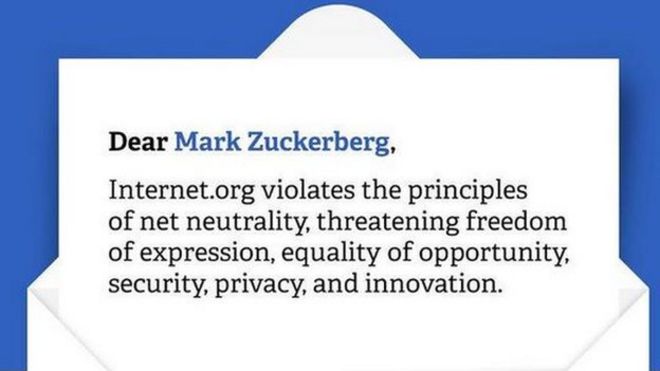
Internet.org is Facebook's effort to expand Internet access into less fortunate areas of the world in order to improve life there. Or at least, that's what they make it seem. Sure, it may do just that for the people there, but it is motivated by nothing but greed on Facebook's behalf. When Internet.org installs Internet access in these places, they offer a very stripped down version of the web. Not only does this version explicitly violate net neutrality, but it strongly benefits Facebook and makes them a monopoly in these areas.

Internet.org only allows for the use of pre-approved websites over its network, which includes, of course, Facebook. They say that this is a necessary measure in order to keep the bandwidth usage down and optimize sites for slower devices and networks. Really, this creates a walled system that discourages innovation and threatens the very freedoms that the Internet stands for.

"It is our belief that Facebook is improperly defining net neutrality in public statements and building a walled garden in which the world's poorest people will only be able to access a limited set of insecure websites and services," stated an open letter to Internet.org, signed by 67 Internet rights groups.

Internet.org also discourages the use of encryption and security of the websites that are allowed on its service. This puts the privacy of everyone who uses it at serious risk. Sure, I know what a lot of people are thinking. "Aren't these limited websites a lot better than no websites for the people who are receiving this service?" Yes, for the time being. If the Internet begins to expand in those regions, it is completely possible that this service could expand into a full-blown monopoly of the Internet in those regions. Facebook has, and will continue to have, complete say in what sites are allowed to be accessed by these people. If that isn't the largest violation of net neutrality you can think of, I don't know what is.

Sources: New York Times, BBC

Piracy is not a victimless crime.

Or at least, that's what the government and copyright protection organisations want you to think. But is that really true? Of course, piracy isn't paying for something that would normally cost money, but there are a lot of factors to consider if it is actually harming anyone. In many cases, people pirate content they would not purchase anyway. Whether because they physically cannot due to region locks or inability to pay for it, or they just didn't think it was worth it, some people would not spend $9.99 on that movie no matter what. Them pirating the movie does not change the end result for the creators of that movie because they wouldn't have bought it anyway. In the end, it may even be beneficial to the movie creators because they could have a new fan that recommends the movie to those who are capable of buying it.

"But there are people who pirate and just don't want to spend any money! It's not because they can't, they're just cheap and stealing from the rightful profits of content creators!" is what you might think. It's reasonable to think this way, but study after study after study have proven that pirates actually spend more money on online media than any other group. Lots of pirates consider piracy to be a "trial" of something, and if they like it they will buy it. Compare that to if piracy didn't exist. They would have no way to try it and would instead move on with their lives and pursue other interests.

In fact, both the film industry and music industry have been growing in terms of profits over the past decade. Piracy isn't the end for entertainment, as much as the government and media want to make you think it is. Organisations like the MPAA seek to increase their already giant profits by preventing people from consuming what creators make. Piracy doesn't stop income, nor does it harm anyone. It isn't even clear if "stopping" piracy, if even possible, would have a positive or negative effect on the industry. Either way, it doesn't matter. Piracy cannot be stopped, so it's about time organisations stopped wasting their money trying to stop it and instead created better content for pirates to want to spend their money on.

Sources: Click the hyperlinked text in the post to view sources.

Technology is developing faster now than ever before, increasing speed exponentially. Inventions like the telephone, computers, and the Internet make sharing information quicker and more convenient than ever. This is the definition of collective intelligence, when individuals connect with each other to create a network of intelligence. But this can only take us so far, right? What happens when we create something smarter than us? What happens when machines take over?

First of all, this isn't science fiction. This is happening right now. People program machines that perform specific tasks, mainly in manufacturing. These are taking many people's real jobs right now. CGP Grey made an amazing video talking about the social and economic consequences of machines taking over human labor. To summarize, a robot can take your job no matter what it is. This doesn't necessarily have to be a bad thing, it's just another economic revolution similar to the industrial revolution. There will be problems because we don't know how to deal with it, but we will eventually. The better prepared we are the easier the transition will be.


Many companies are currently working on software that doesn't just perform specific tasks, but actually learns. This is the growing field of artificial intelligence, which aims to create software that gets better over time through learning from its mistakes. Just yesterday Google announced an update to Gmail which can read an email and provide three contextually generated responses to that email. This seems simple at first, but when you consider that this is a machine generating human-like responses to human input, and then learning to get better, it's really incredible.

But at what point does a machine generating a human-like response turn into actual thought and feeling? After all, the human brain is just like one incredibly intricate computer. The Turing Test, proposed by Alan Turing in 1950 aims to answer that question. The test is simple, a human compares the answers of a machine and a human and tries to reliably tell which one is the machine's answer. If the judge cannot reliably tell that one is the machine, it passes the test. So far, no AI has passed the test, but who knows just how much more learning an AI has to do to reach this status? It's inevitable.

The evolution of technology will not stop there. When I say evolution, I don't mean the biological definition. Evolution is extremely slow, taking thousands and thousands of years for there to be a major difference. Technology is advancing much faster than the rate of biological evolution. Eventually there will be the invention of an AI that sees flaws in itself and constantly improves, or creates other copies of itself that also improves themselves. This exponential explosion of AI-powered technological improvement is known as the technological singularity. The intelligence of such machines could grow to such a scale that humans would no longer be able to keep up, and be drowned out by the intense superiority of the constantly improving AI. There's no way to tell what humanity's role in this situation would be. All that's known is that by developing artificial intelligence, this conclusion is inevitable. The only questions are when, and if the AI will see us favorably.

While the chances of all of these happening are high so long as we continue at the rate of progress we're at, there's no telling whether they will be beneficial or not. I, for one, welcome our robot overlords.

Sources: TelegraphCBC, Wikipedia

In order to understand what a lack of net neutrality can do to society as a whole, I'll have to first explain what it is. To put simply, net neutrality is the concept of Internet service providers treating all content across the web equally. It's what keeps all websites running at nearly the same speed, as long as they keep their servers healthy. Without net neutrality, it's possible for us to see plans like the image I used above. The image is fake, thankfully, but it could be extremely possible if net neutrality isn't enforced.

Verizon and Comcast made headlines in 2014 for requiring Netflix to pay them in order to deliver their service at the same speed as the rest of the Internet. Verizon and Comcast's logic was that since Netflix is taking up so much of their bandwidth, Netflix should pay a fee in order to give it to customers at a fair rate. When you think about it, shouldn't Verizon and Comcast be happy that Netflix is giving them more business? If their customers want faster Internet to watch their Netflix shows, Verizon and Comcast will end up selling more plans, building faster lines, and making this better for everyone! The only problem is, big ISPs don't think that way. They'd rather sacrifice what's best for customers and small businesses in order to make more money. They control the roads that your data is travelling on, so they want to set up toll booths for certain websites. What happens when a Netflix competitor starts up and can't afford to pay ISPs to deliver their content at the same speed as Netflix? They'd lose all their business. Lack of net neutrality creates monopolies across the board.

Thankfully, net neutrality has been a major talking point in politics the past few years. Organizations like Fight for the Future aim to increase awareness and prevent bills violating net neutrality from being passed. Democrats such has Hillary Clinton and Barack Obama have been major supporters of net neutrality, aiming to increase regulation and set up stern rules which would outlaw violations. Unfortunately, not all politicians are in favor of this. Republican Ted Cruz has gone on record against net neutrality. On Facebook he said, "It puts the government in charge of determining Internet pricing, terms of service, and what types of products and services can be delivered, leading to fewer choices, fewer opportunities, and higher prices for consumers,"


Throwing around anti-Democrat buzzwords such as "Obamacare for the Internet" just shows how ignorant he truly is about the subject. The government regulating what ISPs can do isn't going to limit choice or opportunities, it's going to increase them by letting small online businesses grow. Without it, we're going to allow major ISPs to become an even larger monopoly than they already are.


Sources: Time, CNBC, Verge