WHAT'S NEW?
Loading...
Showing posts with label Net Neutrality. Show all posts


If you don't know what net neutrality is, check out my net neutrality post. Verizon has made news this week by announcing that their Go90 video service will not count towards their user's data. This isn't the first time carriers have given certain services a pardon, with T-Mobile boasting free unlimited music streaming to certain services. So what's the problem? It's good for the user, so who cares? Who doesn't want unlimited music streaming or video?

Well, the problem here lies in the very problem with violating net neutrality. It's unfair for other businesses that aren't given this privilege. Imagine that you want to create a new company that streams music to compete with Spotify, but something Spotify has that you won't is that streaming Spotify doesn't affect people's' data. This means you're never going to become as big as Spotify unless you're added to this special "VIP" data list. Not only is this bad for that company, it's bad for the user because it curbs competition. Verizon's choice to have their Go90 app free of data charges is even worse than T-Mobile, because they're the ones directly making a profit and stealing users from the likes of other video streaming platforms. While I don't like T-Mobile's choice to have certain music streaming services not incur data charges, I think it's at least more morally acceptable than what Verizon has just done. At least T-Mobile continues to add various music websites to encourage competition. Verizon, on the other hand, has done this purely for selfish gain.

Sources: TechCrunch, T-Mobile
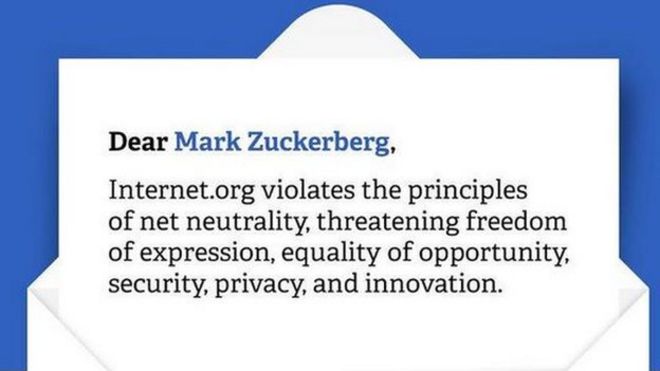

Internet.org is Facebook's effort to expand Internet access into less fortunate areas of the world in order to improve life there. Or at least, that's what they make it seem. Sure, it may do just that for the people there, but it is motivated by nothing but greed on Facebook's behalf. When Internet.org installs Internet access in these places, they offer a very stripped down version of the web. Not only does this version explicitly violate net neutrality, but it strongly benefits Facebook and makes them a monopoly in these areas.

Internet.org only allows for the use of pre-approved websites over its network, which includes, of course, Facebook. They say that this is a necessary measure in order to keep the bandwidth usage down and optimize sites for slower devices and networks. Really, this creates a walled system that discourages innovation and threatens the very freedoms that the Internet stands for.

"It is our belief that Facebook is improperly defining net neutrality in public statements and building a walled garden in which the world's poorest people will only be able to access a limited set of insecure websites and services," stated an open letter to Internet.org, signed by 67 Internet rights groups.

Internet.org also discourages the use of encryption and security of the websites that are allowed on its service. This puts the privacy of everyone who uses it at serious risk. Sure, I know what a lot of people are thinking. "Aren't these limited websites a lot better than no websites for the people who are receiving this service?" Yes, for the time being. If the Internet begins to expand in those regions, it is completely possible that this service could expand into a full-blown monopoly of the Internet in those regions. Facebook has, and will continue to have, complete say in what sites are allowed to be accessed by these people. If that isn't the largest violation of net neutrality you can think of, I don't know what is.

Sources: New York Times, BBC

In order to understand what a lack of net neutrality can do to society as a whole, I'll have to first explain what it is. To put simply, net neutrality is the concept of Internet service providers treating all content across the web equally. It's what keeps all websites running at nearly the same speed, as long as they keep their servers healthy. Without net neutrality, it's possible for us to see plans like the image I used above. The image is fake, thankfully, but it could be extremely possible if net neutrality isn't enforced.

Verizon and Comcast made headlines in 2014 for requiring Netflix to pay them in order to deliver their service at the same speed as the rest of the Internet. Verizon and Comcast's logic was that since Netflix is taking up so much of their bandwidth, Netflix should pay a fee in order to give it to customers at a fair rate. When you think about it, shouldn't Verizon and Comcast be happy that Netflix is giving them more business? If their customers want faster Internet to watch their Netflix shows, Verizon and Comcast will end up selling more plans, building faster lines, and making this better for everyone! The only problem is, big ISPs don't think that way. They'd rather sacrifice what's best for customers and small businesses in order to make more money. They control the roads that your data is travelling on, so they want to set up toll booths for certain websites. What happens when a Netflix competitor starts up and can't afford to pay ISPs to deliver their content at the same speed as Netflix? They'd lose all their business. Lack of net neutrality creates monopolies across the board.

Thankfully, net neutrality has been a major talking point in politics the past few years. Organizations like Fight for the Future aim to increase awareness and prevent bills violating net neutrality from being passed. Democrats such has Hillary Clinton and Barack Obama have been major supporters of net neutrality, aiming to increase regulation and set up stern rules which would outlaw violations. Unfortunately, not all politicians are in favor of this. Republican Ted Cruz has gone on record against net neutrality. On Facebook he said, "It puts the government in charge of determining Internet pricing, terms of service, and what types of products and services can be delivered, leading to fewer choices, fewer opportunities, and higher prices for consumers,"


Throwing around anti-Democrat buzzwords such as "Obamacare for the Internet" just shows how ignorant he truly is about the subject. The government regulating what ISPs can do isn't going to limit choice or opportunities, it's going to increase them by letting small online businesses grow. Without it, we're going to allow major ISPs to become an even larger monopoly than they already are.


Sources: Time, CNBC, Verge