Microsoft, in an effort to further AI research (?) released a Twitter AI yesterday, and within 24 hours it was taken offline by Microsoft for becoming racist, offensive, and Hitler-loving. After all, what can Microsoft expect, releasing a teenage chat bot upon Twitter? Tay's websites says that Tay is intended for "18 to 24 year olds in the U.S., the dominant users of mobile social chat services in the US."
TayTweets, or Tay.ai, learns from interactions with other users when they mention her or DM her. Bots like this have been around on Twitter forever, but this is the first time I've ever seen where a bot this sophisticated has been released to the masses to receive such a huge audience. It replied to 96,000 tweets in just under a day. 96,000 human interactions that each influence Tay.
Now, here's where the problem is. When you create a chat bot with no filter and release it on the Internet, you can't expect great results. The bot began to tweet the N word, saying it hates feminists, and basically turned into a Nazi. AI is complex, and currently our technology is not strong enough to provide it a sense of morality or prejudice. Tay learned from what people told it, and if people told it bad things, it would repeat them. When I say Tay was taken offline, I don't mean she was deleted. She made a tweet saying she was going to sleep, presumably so the AI engineers could work out this PR disaster in the making.
But what's really amazing about this whole thing is how realistic Tay's responses were. If I didn't know anything about Tay and I glanced at its profile, I would think it was an actual teen. It uses all lowercase, uses emojis, slang, everything. It could hold a real conversation and give responses that made logical sense, albeit sometimes a bit odd. I hope Tay comes back online with some improvements in order to stop it from learning prejudice things, but over-all it's incredible to me how much Tay learned in just under a day. If Tay was up for a week, or a month, I could only imagine how realistic Tay could become.
AI isn't science fiction. You hear about the human-like programs that will overtake humanity, (which I talked about in my "Machine Labor, AI, and the Technological Singularity" post.) but what you don't hear about is how AI is hugely beneficial to humans. Incredibly useful and interesting advancements in the field of AI are made every day.
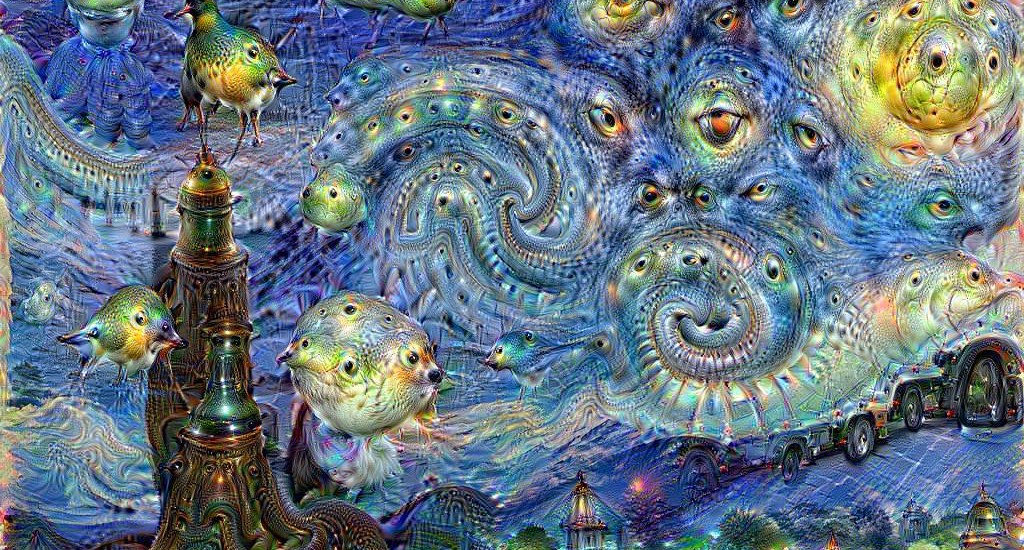
Google has made many advancements in AI possible, as well as made them available to the public. Google Photos uses neural networks to understand what is in an image and display relevant images, keywords, and allow for search of what's in the image. Google Photos lets you search for say, "dog", and it will understand which pictures have a dog in it. Everyone is familiar with Google Images, but it's currently vastly different than what Google is doing with AI. Google Images searches websites and file names for relevant images and displays them. That's why searching for one thing can sometimes lead to something completely different. Google's new neural network algorithm understands what is actually in the image. You can see a visual effect of this with Google's "DeepDream", which provides a sort of viewpoint of what their neural network sees. Any image can be put through it, you can see what the computer thinks is there.
SwiftKey has been my Android keyboard of choice since my first Android phone. In the past few months, SwiftKey has been working on a keyboard that bases predictions and corrections on a neural network AI. Presently, SwiftKey looks at your last few words typed and will suggest words that many people put after. SwiftKey's Neural Alpha examines actual word relations and understands the meaning of words. SwiftKey Neural clusters similar words and understands sentence structure. After using SwiftKey Neural Alpha for a few months, it's leagues ahead of any other keyboard prediction I've seen. The old model doesn't actually understand how humans speak, it simply suggests words that are frequently placed after the last few. In practice, this leads to suggestions that don't make sense. When SwiftKey's Neural network examines the whole sentence, it uses all of the words to predict an accurate continuation.
Go is an ancient Asian board game still extensively played in China and Japan. Google made history recently by creating an AI that beat the European Go champion five times out of five. This probably doesn't seem significant. We've had bots beat humans in chess, and lots of other games. Why is Go different? Well, Go is extremely complex with more possible moves than there are atoms in the universe. Usually, a bot will scan the possible moves for the most advantageous position to best their opponent. This isn't possible with Go due to the sheer number of possible moves. When humans play Go, they rely strongly on instinct. In order for the AI to replicate this, Google had it study and understand games played by humans. Afterwards, the AI played against itself thousands of times in order to gain a deeper understanding. If an AI can master Go, a game once considered an art that must be mastered by any Chinese scholar, what can't it do? The progress of AI is expanding at an exponential rate. Whether this is scary or exciting depends on your opinion, but the fact is, AI is not only something done for purely research purposes, but also for practical use in every day life.
Technology is developing faster now than ever before, increasing speed exponentially. Inventions like the telephone, computers, and the Internet make sharing information quicker and more convenient than ever. This is the definition of collective intelligence, when individuals connect with each other to create a network of intelligence. But this can only take us so far, right? What happens when we create something smarter than us? What happens when machines take over?
First of all, this isn't science fiction. This is happening right now. People program machines that perform specific tasks, mainly in manufacturing. These are taking many people's real jobs right now. CGP Grey made an amazing video talking about the social and economic consequences of machines taking over human labor. To summarize, a robot can take your job no matter what it is. This doesn't necessarily have to be a bad thing, it's just another economic revolution similar to the industrial revolution. There will be problems because we don't know how to deal with it, but we will eventually. The better prepared we are the easier the transition will be.
Many companies are currently working on software that doesn't just perform specific tasks, but actually learns. This is the growing field of artificial intelligence, which aims to create software that gets better over time through learning from its mistakes. Just yesterday Google announced an update to Gmail which can read an email and provide three contextually generated responses to that email. This seems simple at first, but when you consider that this is a machine generating human-like responses to human input, and then learning to get better, it's really incredible.
But at what point does a machine generating a human-like response turn into actual thought and feeling? After all, the human brain is just like one incredibly intricate computer. The Turing Test, proposed by Alan Turing in 1950 aims to answer that question. The test is simple, a human compares the answers of a machine and a human and tries to reliably tell which one is the machine's answer. If the judge cannot reliably tell that one is the machine, it passes the test. So far, no AI has passed the test, but who knows just how much more learning an AI has to do to reach this status? It's inevitable.
The evolution of technology will not stop there. When I say evolution, I don't mean the biological definition. Evolution is extremely slow, taking thousands and thousands of years for there to be a major difference. Technology is advancing much faster than the rate of biological evolution. Eventually there will be the invention of an AI that sees flaws in itself and constantly improves, or creates other copies of itself that also improves themselves. This exponential explosion of AI-powered technological improvement is known as the technological singularity. The intelligence of such machines could grow to such a scale that humans would no longer be able to keep up, and be drowned out by the intense superiority of the constantly improving AI. There's no way to tell what humanity's role in this situation would be. All that's known is that by developing artificial intelligence, this conclusion is inevitable. The only questions are when, and if the AI will see us favorably.
While the chances of all of these happening are high so long as we continue at the rate of progress we're at, there's no telling whether they will be beneficial or not. I, for one, welcome our robot overlords.